1 September 2026
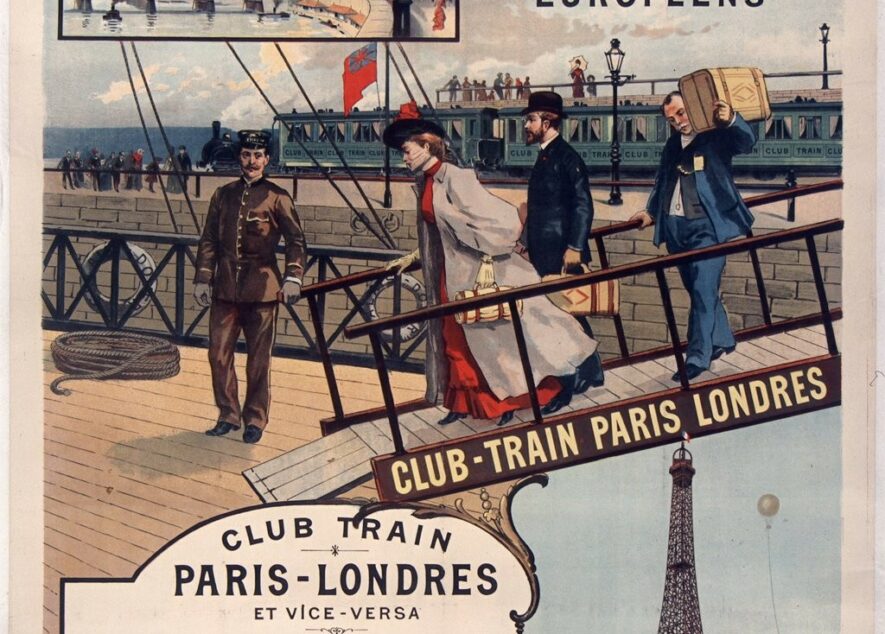
As part of our exhibition The Orient Express, A Modern Epic (1883–1918), discover how the Compagnie Internationale des Wagons-Lits transformed rail travel into an unprecedented luxury experience.
At the end of the 19th century, the development of the railway profoundly transformed the way people travelled in Europe. A visionary, the Belgian engineer Georges Nagelmackers founded the Compagnie Internationale des Wagons-Lits (CIWL) – International Sleeping Car Company – in 1876 with the aim of offering its passengers a comprehensive travel experience, combining comfort with a range of services.
Initially, the company offered to operate carriages on behalf of various partner railway networks along their lines. The CIWL took a further step by creating international trains consisting exclusively of luxury carriages. In 1882, the experimental train, named the Train-Éclair, ran from Paris to Vienna to demonstrate to both travellers and railway companies the advantages of this new way of travelling.
This success paved the way for the Orient Express, which made its maiden journey from Paris on 4 October 1883, as well as for the construction of a vast European network, including notably the Club-Train, the Calais-Méditerranée-Express, the Nord-Express, the Flèche d’Or and the Trans-Siberian.
The company’s expansion was accompanied by a major drive towards internationalisation. In order to ensure a consistent standard of service across its entire network, the CIWL established travel agencies, known as ‘Wagons-Lits’ – Sleeping cars -, and set up a network of workshops for the construction and maintenance of rolling stock. In 1894, it took a further step forward with the creation of the Compagnie Internationale des Grands Hôtels – International Grand Hotels Company -, designed to accommodate travellers in prestigious establishments near major railway stations and tourist destinations.
Visual : Gustave Fraipont (1849-1923) pour Chemins de fer du Nord français du London Chatham et du South Eastern, CIWL, édition Champenois, Paris, Club-Train Londres et vice-versa, 1891, lithographie, Collection Michel Cozic

 Accès
Accès Horaires
 Agenda